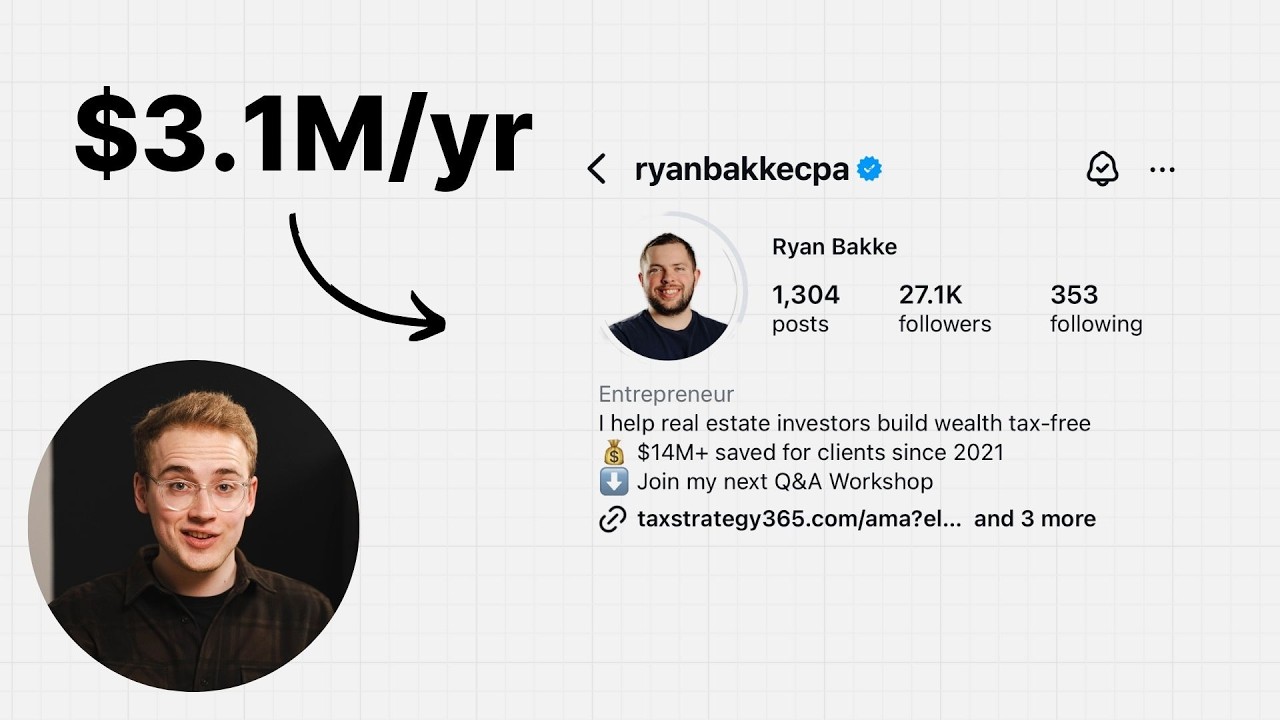
One of my clients made $8,708 a day last year. Divide $3.1 million by 365 and that is the number. He sells a yearly tax strategy service for $5,000 and upsells everyone into tax preparation each spring. His average client is worth $7,000 to $10,000 per year.
Here is the marketing funnel, the traffic system, and the ROI tracking that made it happen.
The Three-Step Funnel
We keep things simple. A lot of marketers make funnels seem overwhelming with fancy moving pieces all interconnected. But from a conceptual standpoint, this system has three steps: a video sales letter, an application, and a discovery call.
That is really all you need to book 100 to 150 calls a month and close roughly 25% of them.
The video sales letter is a landing page with a video walking through who this service is for, what the outcome is, and proof that it works. The critical thing here is that most accountants sell their service as a list of line items — payroll, bookkeeping, three strategy calls a year. But that is not what the customer is buying. They are buying the outcome. For a tax strategy offer, the headline is simple: how real estate investors can pay little to nothing in taxes. That is what people want.
For less obvious offers like CFO services, you have to dig deeper. They do not want a financial strategy. They want the peace of mind that comes from having one. They want the ease of navigating big moves in their business. The term “financial strategy” does not mean anything to a prospective client because they do not understand what it does for them.
Testimonials matter, but volume matters more. If you are smaller, prioritize video testimonials — get on a Zoom call, interview the client about their experience, and use three or four of those. They go a long way. If you are a more mature firm with hundreds of success stories, lean into volume. Ryan has 15+ testimonials on his page, and on mobile you just keep scrolling through them. It creates the same effect as choosing the restaurant with 5,000 reviews at 4.6 stars over the one with 50 reviews at 5 stars. Volume bias is real.
The application is you vetting the prospect. A lot of accounting firms put too much friction here — too many questions, too many text fields that require thinking. The problem is that people who make a lot of money do not have a lot of time. They are not going to stick around for a form that asks 15 questions.
Ryan’s application asks for first name, last name, phone, email, total income (dropdown), and number of rental properties (dropdown). Anyone under $200K gets filtered out with a polite redirect to free content. Both qualifying questions are dropdowns, not text fields. Any question that requires the prospect to think is a bad idea. We want this to be robotic — qualifying based on general facts that come to mind instantly.
The discovery call is where most firms get it wrong. They treat it as a qualification call — asking a bunch of questions to figure out which service to pitch, then basically going, “Sounds like we can help. Here is our service.” That is no way to sell anything.
The real objective is to create a gap between where the prospect is now and where they want to be. Start scripting from the pitch at the end, then work backward to figure out what questions get the prospect to articulate their own pain. If you can get them to say something like, “I am paying a lot in taxes, my local CPA does not do any strategy for me, he says no to all my suggestions, and I feel like he does not really care about me” — that is all you need to bridge into your offer.
Getting Traffic Into the Funnel
Once the funnel is built, it is really just about getting people into the system. I think of it like an assembly line — content and ads are just sending raw materials (cold leads) into the funnel, where they get warmed up, educated, and come out the other end as warm leads booked on your calendar.
For Ryan, we post organically on Instagram, Facebook, TikTok, LinkedIn, and Twitter. We run paid ads on Facebook and Instagram. And we publish a podcast across YouTube, Spotify, and Apple. The objective is omnipresence.
This connects to something called the 7-11 rule. Google did a meta-analysis on a large general social survey and found that people need to spend seven hours with you across 11 different touchpoints in four different locations before they become a dedicated customer of your brand. That is why all these platforms matter.
And all roads lead to Rome. Rome is the funnel. Whether they find Ryan on LinkedIn, Instagram, through a podcast, or from an ad, they all end up in the same optimized funnel. No exceptions.
Tracking ROI: Two Metrics That Matter
Without data tracking, you are just throwing stuff out there and hoping it works. We use a software called Hyros to track every call that books on Ryan’s calendar — both where the person first found us (origin source) and the last thing they clicked before booking (last source).
An interesting finding: the majority of people ultimately book by Googling the company name, even when they first discovered Ryan through an ad or social content. This is why making it easy for people to Google you matters so much.
Metric 1: ROAS (Return on Ad Spend). New revenue divided by ad spend. This is a short-term measure of how scalable your paid ads funnel is. Target a 4-to-1 or 5-to-1 ratio. Some clients run as high as 10-to-1 or 12-to-1, but four or five is a reasonable expectation. If you are below break-even, something needs to change.
Metric 2: LTGP to CAC (Lifetime Gross Profit to Customer Acquisition Cost). This is the long-term measure. Lifetime gross profit is how much a client pays over their entire lifetime with you minus the cost to deliver the service. Customer acquisition cost is your total marketing and sales spend divided by number of new customers — and that means all costs, not just ad spend. If you are paying an agency $3K a month and spending $2K on video editors for social content on top of $5K in ads, your total marketing spend is $10K.
If you are seeing a 4-to-1 ratio here, that is decent. An 8-to-1 or higher usually means you have stumbled onto an opportunity with a limited window. Make hay while the sun shines.
The long-term play is to get CAC to a respectable number and then spend all your energy increasing lifetime value. You can only budget your way down to zero on acquisition costs. The amount you can make from a client is theoretically infinite if you build services that keep them for years.
Frequently Asked Questions
What is a video sales letter funnel for accountants?
A VSL funnel is a landing page built around a video that explains who you help and the outcome you deliver, stacked with testimonials and social proof, followed by a short application and a calendar booking page. The video does the heavy lifting so prospects can self-select in or out before they ever get on the phone with you.
How many steps should a marketing funnel have for an accounting firm?
Three core steps: a video sales letter page, an application form, and a discovery call booking. Most marketers overcomplicate this with extra pages and fancy tech. These three elements are enough to book 100 to 150 calls a month and close roughly 25 percent of them, which is about what we did last year with Ryan’s firm.
What is ROAS and what should accountants aim for?
ROAS stands for return on ad spend. You calculate it by dividing new revenue generated from ads by the amount you spent on those ads. A 4-to-1 or 5-to-1 ROAS is a solid target for most accounting firms, meaning you make $4 to $5 back for every dollar you spend. Some firms run higher, but four to five is a reasonable long-term expectation.
What is LTGP to CAC and why does it matter?
LTGP to CAC is lifetime gross profit divided by customer acquisition cost. It measures long-term scalability. Make sure you include all marketing and sales costs in your CAC — not just ad spend, but also agency fees, software, and content production costs. A ratio of 8-to-1 or higher usually signals a major growth opportunity you should invest in aggressively before the market catches up.
How should accountants use testimonials on their sales pages?
If you are a smaller firm with fewer clients, prioritize three or four video testimonials from real Zoom interviews about the client experience. If you are more mature with hundreds of clients, lean hard into volume. Fifteen or twenty testimonials on a single page creates a powerful volume bias that is often more persuasive than a handful of perfect reviews.
Want help scaling your firm?
If you're an accounting firm owner looking to build a predictable client acquisition system, let's talk.
Get in Touch
![How This Bookkeeper Scaled From $30k/mo → $92k/mo in 2025 [LIVE WORKSHOP RECORDING]](https://i.ytimg.com/vi/U6QCPbCaioE/maxresdefault.jpg)