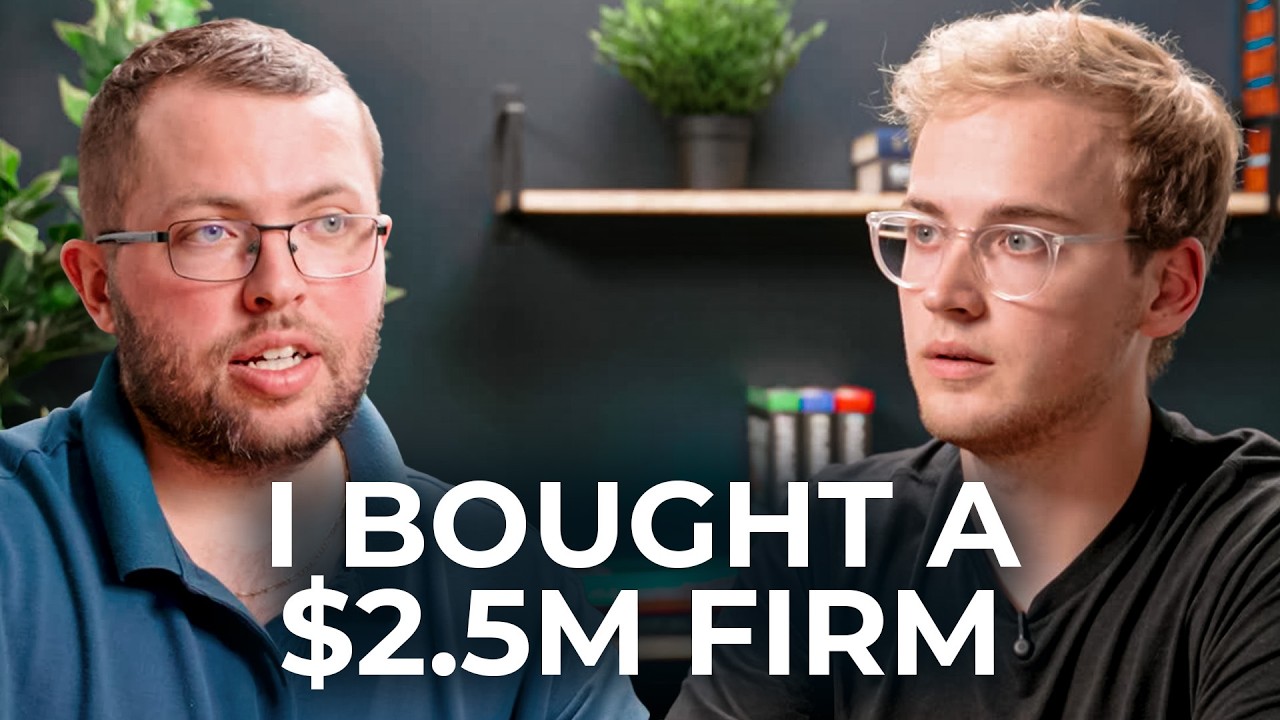
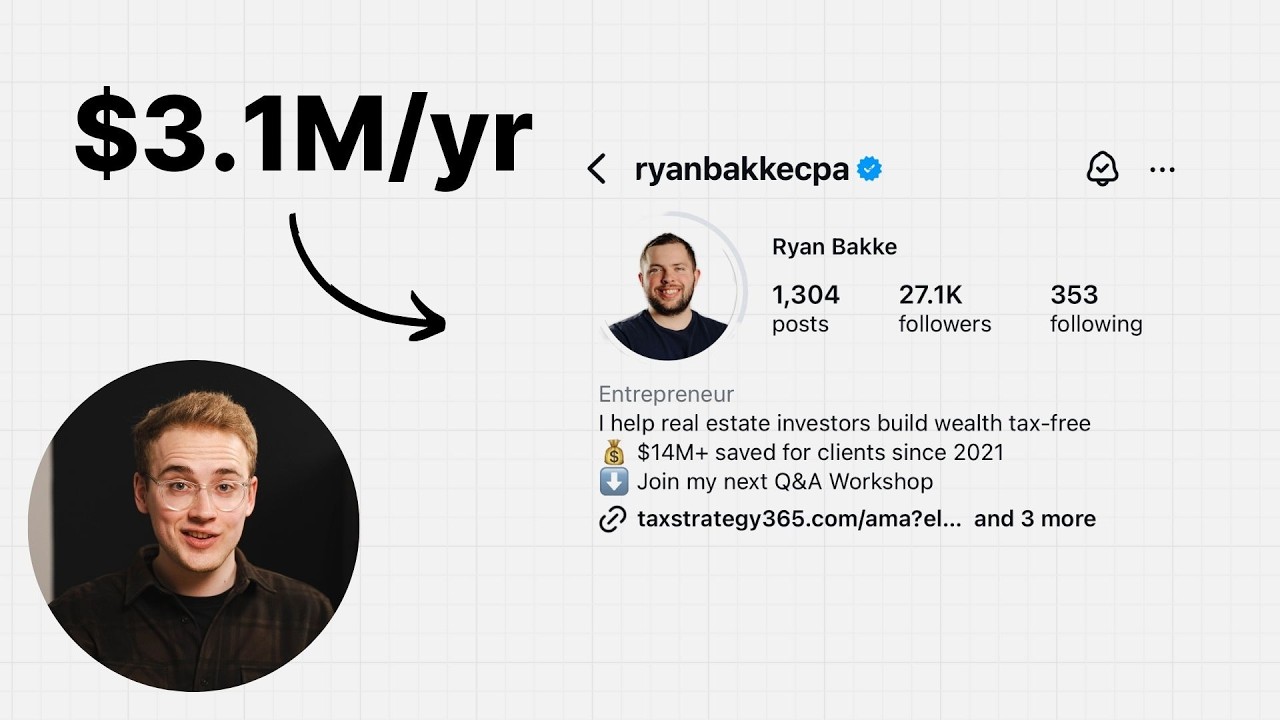
Ryan Bakke owns Tax Strategy 365, a real estate CPA firm. We have been working together since the very beginning. In 2021, he did about $100,000 in revenue while still working his 9 to 5. In 2022, he quit his job and hit $850,000. In 2023, he crossed $1.6 million. And by the end of 2024, he closed out at just under $3 million.
This is the breakdown of the marketing, sales, and operations moves that made that growth possible.
The Marketing Machine
For the entire time we have been working together, Ryan has had his podcast going out every week on YouTube and Spotify, plus short-form content across Instagram, TikTok, LinkedIn, and Twitter. For a while, that was the main source of traffic.
But the real turning point in 2024 was cracking the paid advertising channel. We built a VSL funnel that lets us put a dollar in and get roughly a 6x return on ad spend. Beyond the leads that convert immediately, every lead gets added to his email list. We think of it like all roads lead to Rome, and Rome is the email list. Once someone is on that list, we can direct them to the podcast, the Facebook group (which is now over 10,000 real estate investors), or back to the sales funnel whenever we want.
Ryan put it well: you do not always want the people who convert right away. Someone who has been in your audience for six or seven months is much easier to sell than someone who just heard of you this week. It is 10 times harder to sell to a cold lead than someone who has had the conversation before the conversation with you for months.
The Qualified Lead Problem
Most accountants think they do not have a lead problem because their phone is ringing. They do have a lead problem. They have a qualified lead problem.
Ryan would rather get on the phone with 10 people who are super qualified and showing real pain than 100 unqualified people who will waste his sales team’s time. So we set hard filters. You cannot book on Ryan’s sales calendar if you are making under $200,000 a year. That is a minimum qualification. We also filter through the messaging itself, always refining what language and concepts attract higher-level prospects.
And here is something most firms get wrong: they just boot unqualified leads and never capture their information. Ryan treats unqualified leads like they are still valuable. They get funneled into a lower-priced offer, a course, a boot camp, or a live event. They stay in the ecosystem getting nurtured through content and email until they are qualified. And when they are ready, it is a much easier sale because they have already built trust with the brand.
The key insight is that telling the world who you work with also tells the world who you do not work with. That filter works in your favor on both ends.
Building the Downsell the Right Way
Ryan did not create a downsell offer until the high-ticket tax strategy service was completely dialed in. That is a mistake I see all the time: firms create a cheaper option too early because they are getting unqualified leads and they want to capture some revenue. That is not the solution.
The best advice Ryan got on downsell offers: take the most common objections to your main offer (other than price) and build a front-end product that addresses those objections. If people say they do not have enough time, or they are not sure it will work for them, strip down the main offer and create something lighter that gives them a taste. But do not just sell 75% of the value for a third of the price. That is how you cannibalize your own high-ticket offer.
Ryan learned this the hard way early on. He was charging $500 for one-hour consultations and was making $25,000 a month from those calls alone. But his mentor told him the truth: he was giving away so much value in that one call that clients felt like they did not need him for the rest of the year. Instead of doing ten $500 calls, he could do ten sales calls, close three of them into a $5,000 package, and make three times as much while working with fewer people.
Selling the Plan Out of Hell
When Ryan brought on sales reps, he had to completely rethink the sales approach. When you are the founder, people want to work with you because they have seen your content and built a relationship. But when a sales rep is on the line, prospects do not have that same connection.
The fix was shifting from selling the destination to selling based on the prospect’s pain. Instead of leading with the dream outcome, lead with a deep understanding of the problem. Whoever demonstrates the clearest understanding of the prospect’s problem gets the privilege of solving it.
Ryan describes it this way: 90% of the sales conversation, all the way up until they buy, should be focused on the negative. The pain. The problems. The cost of doing nothing. Once they have committed and made the purchase, then you switch to positive motivation and get them excited about what comes next. But up until that point, stay in the pain.
When you sell based on the problem rather than the person, it does not matter whether Ryan or a team member is delivering the service. The client is buying a solution to their pain, not a relationship with a specific person.
Getting Out of Fulfillment
Every business has three elements: traffic, the offer, and fulfillment. For most of 2024, the bottleneck in Ryan’s business was Ryan himself. He had traffic figured out. The offer was dialed in. But he was still doing all the fulfillment.
When he hired Austin as his first tax strategist, the challenge was not just filling the role. It was transferring authority. Clients would get on a call with Austin, hear his recommendations, and then ask Ryan if Austin was right. Ryan had to firmly establish that Austin was the expert in this area and was actually better at a lot of the day-to-day tax strategy work.
The way Ryan transferred that authority is something we call the Drake Feature. When Drake features a new artist on his song, he is transferring his credibility and audience to that artist. Ryan did the same thing for Austin. He name-dropped Austin constantly in pre-call videos and emails. He brought Austin on webinars so prospects could interact with him before becoming clients. He had Austin on the podcast. He flew Austin to Chicago to do content together.
The principle behind this is critical: if you as the CEO are the cap on your organization, your business can only grow as fast as you grow. The best companies are built so the CEO is arguably the least specialized person in the room. Everyone else on the team is smarter and more capable in their specific domain. That is how you build something that does not depend on you.
Building Systems Around a Niche
Ryan’s tax preparation side of the business runs almost entirely without him. This is possible because of how specific the niche is. When you only work with real estate investors, there are only so many things that can happen with a deal: you buy a property, it succeeds, you rent it out, maybe you sell it. That predictability lets you build systems, templates, automations, and workflows around a finite set of scenarios.
His process flows from client communication through preparation, first-level review, and then a second-level review by a US-based CPA before delivery. It runs on autopilot until something breaks, which usually only happens during deadline crunches. And the solution to that is having backup personnel ready, not the owner jumping back in.
The Power of In-Person Events
One of the most underrated growth moves Ryan has made is investing in in-person relationships. His longest-tenured clients are almost all people he has met face to face at some point. Going to industry conferences, meeting up with clients at events, and even hosting a house party for clients during a conference in Nashville all contribute to a stickiness that no amount of digital marketing can replicate.
As AI pushes the low end of accounting toward hyper-efficient, impersonal service, the firms that thrive will be the ones that lean the other direction. Build real relationships. Create in-person touchpoints. Give clients a reason to stay that has nothing to do with price.
The Takeaway
Ryan’s story is proof of what happens when you nail all three elements of a business: traffic, offer, and fulfillment. He built a personal brand, cracked paid advertising with a strong VSL funnel, created a sales process that does not depend on him, and hired a team that can deliver without him being in the room.
If you are under $500,000 a year, you are not really a business yet. You are a solopreneur. Use that as an advantage on sales calls. People love working directly with the owner. But start planning your exit from the day-to-day now, because the plateau is coming. And when it does, you want the systems and people in place to break through it.
Frequently Asked Questions
How do I scale a CPA firm to $3 million in revenue?
You need all three elements working: traffic, offer, and fulfillment. Crack paid advertising with a strong VSL funnel, build a sales process that doesn’t depend on you, and hire a team that can deliver without you in the room. Ryan Bakke did exactly this — $100K to $3M in three years.
What is a VSL funnel for accounting firms?
A VSL funnel is a video sales letter paired with an application process. You run paid ads to a page with a 5 to 6 minute video explaining who you help and how, stack proof underneath, and let qualified prospects book a call. Ryan Bakke’s VSL funnel generates roughly a 6x return on ad spend.
How do CPAs get out of doing all the client work themselves?
Start by doing a two-week time audit of everything you do. Then hire for the roles where someone else can handle the work, and transfer your authority to them deliberately — name-drop them in content, bring them on webinars, and let clients interact with them before onboarding. We call this the Drake Feature method.
How should accountants handle unqualified leads?
Don’t just boot them and lose their information. Funnel unqualified leads into a lower-priced offer — a course, bootcamp, or live event — and keep nurturing them through content and email. When they grow into qualified prospects, it’s a much easier sale because they already trust your brand.
What is the best sales approach for accounting firms?
Sell the plan out of hell, not the path to heaven. Spend 90% of the sales conversation focused on the prospect’s pain, problems, and the cost of doing nothing. Once they commit and buy, then switch to positive motivation. Whoever demonstrates the clearest understanding of the problem gets the privilege of solving it.
Want help scaling your firm?
If you're an accounting firm owner looking to build a predictable client acquisition system, let's talk.
Get in Touch
![How This Bookkeeper Scaled From $30k/mo → $92k/mo in 2025 [LIVE WORKSHOP RECORDING]](https://i.ytimg.com/vi/U6QCPbCaioE/maxresdefault.jpg)